

Fort Pierre’s Love Affair with Wagon Trains & Trails
By Sunny Hannum
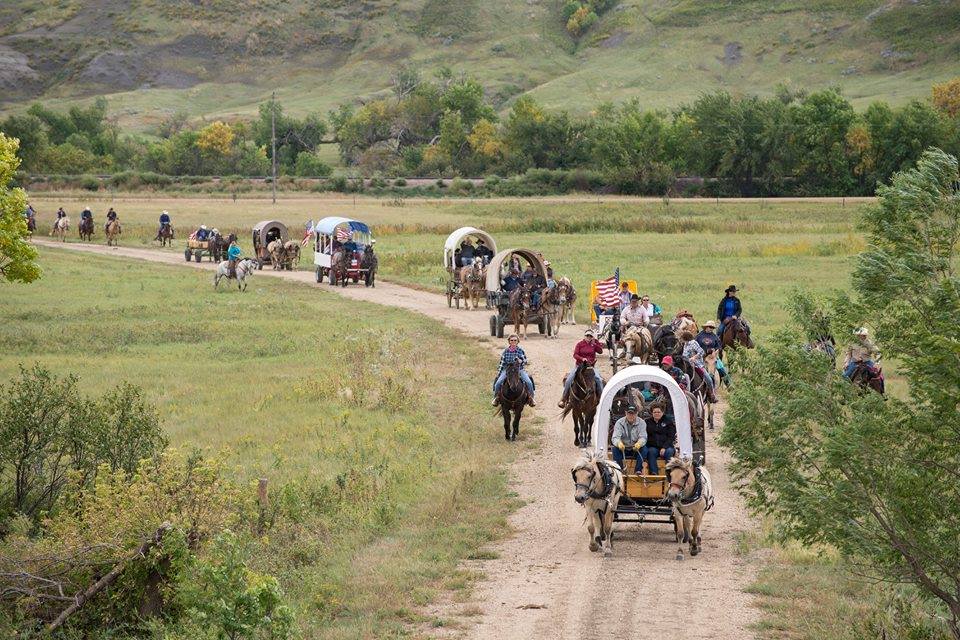
It seems like every few years someone in Fort Pierre or the surrounding area organizes a wagon train. Usually Fort Pierre’s Verendrye Museum is involved and this year of America’s 250th Birthday is no exception. Museum board member, Darby Nutter is planning a wagon train that will start out in the Hayes Community and go south to Bad River through what used to be the Dick Williams ranch. Cody Williams, Dick’s son, is now president of the Verendrye Museum Board. The wagon train was planned for the week of July 4th but is being considered instead for sometime this fall.
In 2008, the Verendrye Museum Board of Directors and others across South Dakota celebrated the 100th Anniversary Commemorative Trail Ride (1908 the Old Deadwood Trail was officially closed) with over 500 people involved in the Trail Ride to Deadwood during a two week period from July 29th through August 7th 2008.
In 2009, also produced by Fort Pierre’s Verendrye Museum and officially named “Fort Bennett to Fort Pierre: The Casey Tibbs Memorial Ride,” the event was limited to 300 paying participants and filled up quickly. People were allowed to travel on horseback, on foot or atop a buggy, wagon, stagecoach of other historical vehicle of choice. This was a five day ride of 60 miles with night camps at various locations. The wagon train coincided with the opening of the Casey Tibbs Rodeo Center and this writer had the good fortune to have a good horse and to go on this ride. I had also done the Deadwood ride but only for one day. One of the highlights of this ride was going through the Ted Turner buffalo ranch and being chased by a herd of young buffalo the third day. My dad’s father’s homestead (Hannum) was on this ranch and my mom’s family’s (Tibbs) was near Mission Ridge which we passed the second day.
In 2011, Verendrye Museum did it again, organizing the Scotty Philip Memorial Trail Ride from July 16-23, 2011. Local historian Lonis Wendt put together a wonderful map of this adventure which is available for sale at the Log Cabin Visitor Center in Fort Pierre as are the Deadwood Trail maps. The Scotty Philip Ride from July 16-23 was, I was told, a grueling experience as the weather was extremely hot and humid after a week of heavy rains. It was hard going for horses and riders as they traveled from Philip to Fort Pierre along the Bad River. All of these rides had local historians who gave history talks at the evening camps and this one was no exception. I attended a history talk on the Carlisle ranch south of Fort Pierre the last night of the ride.
If you did not know it, many old trails started at Fort Pierre or converged here on the banks of the Missouri. One of the famous South Dakota trails is the Fort Pierre to Deadwood Trail (1876 to 1906) began here where steamboats would dock and goods would be transferred to the ox driven wagon train for the grueling trip to Deadwood, South Dakota. Following the discovery of gold in Deadwood in 1875, hordes of prospectors, gamblers and storekeepers headed for the Black Hills which was in the heart of the Great Sioux Reservation. The fact that they were trespassing on Indian land didn’t stop them and they kept coming from all directions.
The shortest route to Deadwood was by steamboat from Yankton to Fort Pierre and then this famous trail taking them across prairie and creeks to Deadwood. As Roy and Edith Norman grew into their retirement years, they had the foresight to leave a legacy by surveying and placing fifty-two signs approximately every two miles marking the Fort Pierre to Deadwood Trail from the Missouri River Bridge in Fort Pierre to the Pennington County line in South Dakota. Other people agreed to complete the trail from the Pennington County line on into Deadwood. Roy lived in Grindstone in his younger years and then moved to Fort Pierre and the Fort Bennett area before settling near the Kirley/Sansarc/Hayes area to raise his family.
During Norman’s life, he rode horse and became familiar with the original trails of the Native American Indians, the Army & Military posts and trails, the US Mail routes, Telegraphs routes homesteads, Post Offices and towns in Haakon and Stanley County which were all important to the settlements of western South Dakota. Roy dropped out of school in the 9th grade to help his family make a living but his knowledge of history and familiarity of Haakon and Stanley County sites/trails helped him mark the trails, routes, towns, road ranches, stage stations, original wagon ruts, etc. and tell the story of these historic landmarks.
Norman and his wife did the research, wrote the stories and then began making the signs with the help of their families, hired hands and others to build and place over 350 wooden signs (average cost was $86/sign) from 1975-1979 on eight different trails in central SD from the Cheyenne River south to Nebraska border and west from the Missouri River to the Pennington County line and into the Badlands (over 900 miles of trails) covering fourteen counties (Dewey, Gregory, Haakon, Jackson [Washabaugh), Jones, Lyman, Meade, Mellette, Pennington, Shannon, Stanley, Todd, Tripp, Ziebach). They traveled these trails several times when surveying, marking and placing the signs as Roy never put a sign up which he wasn’t certain it belonged there, traveling over 3,000 miles and Roy used crutches so it was a good workout! “The heritage should be kept in front of the people.” Roy Rogers Norman [Edith Mae (Fackelman) Norman (73) passed away in 1980 and Roy Rogers Norman (82) passed away in 1983)
These famous trails from the Cheyenne River south to the Nebraska state line and from the Missouri River west to the Black Hills and Pine Ridge are as follows: These famous trails from the Cheyenne River south to the Nebraska state line and from the Missouri River west to the Black Hills and Pine Ridge are as follows:
1. Old Deadwood Trail opened up the western part of South Dakota for homesteaders and travel to the Black Hills where the Gold Rush spurred on the creation of Deadwood and other communities and Post Offices along the trail (signs erected 1975).
2, Indian Trails in central SD included Chiefs Spotted Tail, Hump, and Sitting Bull from Leslie/Cherry Creek area to Rosebud and the Black Hills (signs erected 1976-1978).
3. Ft Bennett (near the mouth of the Cheyenne River and a few miles west of Pierre) Army Trail was an old Indian Trail used by Indians in 1830 in 1868 to 1881. The Cheyenne Agency was operated at Ft Bennett. The Military used the Trail from Ft Rice, ND thru Ft Bennett to Ft Kearney, Nebraska (signs erected 1977).
4, Old Dupree Trail was used by Indians to take their children to Pierre to attend winter session of school. Many wagons traveled together every spring/fall around the turn of the century (signs erected 1977).
S. Cherry Creek Indian Trail to Pierre Indian School was used by many Indians from early 1890 into 1920’s. Long strings of wagons were often seen during spring and fall coming to and from the Indian School (signs erected 1977).
6. Old Indian Trail to Pierre Indian School from Cheyenne Reservation past Lindsay over Lindsay Buttes, Standing Buttes, Yellow Hawk Buttes each fall/spring-caravans a mile long of Indian wagons, kids (signs erected 1977).