By Sunny Hannum
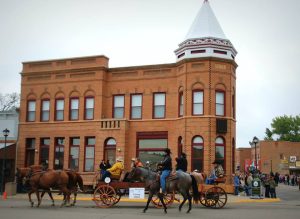
This year America celebrates its 250th birthday and Fort Pierre, the oldest town in Dakota Territory, will hold its 200th Fourth of July celebration. Established as a fur trading post by 1817, Fort Pierre began celebrating 4th of July along with the young country. America which would have been only 41 years old in 1817.
Fort Pierre has been included as one of the South Dakota Tourism’s 25 event locations for the State’s “Grit & Glory” statewide celebration. Fort Pierre has titled their celebration “Boots & Roots” and is already planning 5 days of rodeo beginning June 30 and ending on July 4th. Besides rodeo related events, there will be two large fireworks displays, one on June 30 and one on 4th of July. There will also be two historical statue unveilings in Fort Pierre’s new Tatanka Trail Park. The statue unveilings are Native American statues. One is a large buffalo created by John Lopez which has been named “Dupree” in honor of the man who saved the buffalo, Fred Dupree.
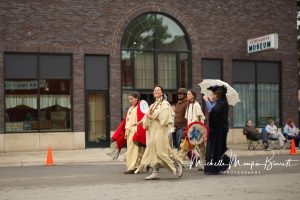
The unveiling of “Dupree” has generated the involvement of the Dupree family from Cheyenne River Reservation and many family members who live in South Dakota and in other states. Expectations are that 300 Dupree family members could participate in an honoring ceremony with drummers and dancers. They also plan to have native riders in the parade on July 4th carrying the flags of all 7 council fires and a Dupree family float.
My mom, Katie Hannum, in an interview with the Capital Journal published July 3, 1992 said, “I remember that the Indians would come in a week ahead of the rodeo and the hills would be covered with tepees and wagons. They would beat on their drums and dance and dance and dance.”
The 1992 4th of July rodeo was dedicated to Lloyd (82) and Katie Hannum (72) who had promoted the rodeo for years. Lloyd said he couldn’t even estimate the number of Native Americans who traveled from the reservations to Fort Pierre for the rodeo in the 1920s and 1930s. “Where the main gate is at the fairgrounds and that hill above it, it used to be a solid mass of tepees and wagons.”
The Hannums remembered when the fairground was built in the current location in 1920. Before that the rodeo was held near where the football field is now located in Fort Pierre as long ago as 1915. “It used to be we didn’t have any arenas – no bucking chutes. It was done out in the open with blindfolded horses. The rider got on and the blindfold came off and away they went.”
Back then, it wasn’t just a rodeo but a Stanley County Fair. According to Lloyd Hannum, ranchers used downtown Fort Pierre as an open market to display their stallions and livestock. Hannum attended his first rodeo at the age of 6 in 1916. He said, “Rodeo evolved from ranching; it was a way of life. There was never a morning when you saddled up that you didn’t go for a bronc ride and sometimes even at the end of the day.”
The rodeo – as it is today – was based on the daily activities of the cowboys on the range and was sometimes a rowdy competition. “It was just when a bunch of the boys would meet to decide who was the best riders and the best ropers,” said Hannum.
(Excerpts from Hannum Interview in Capital Journal July 3, 1992 Edition)
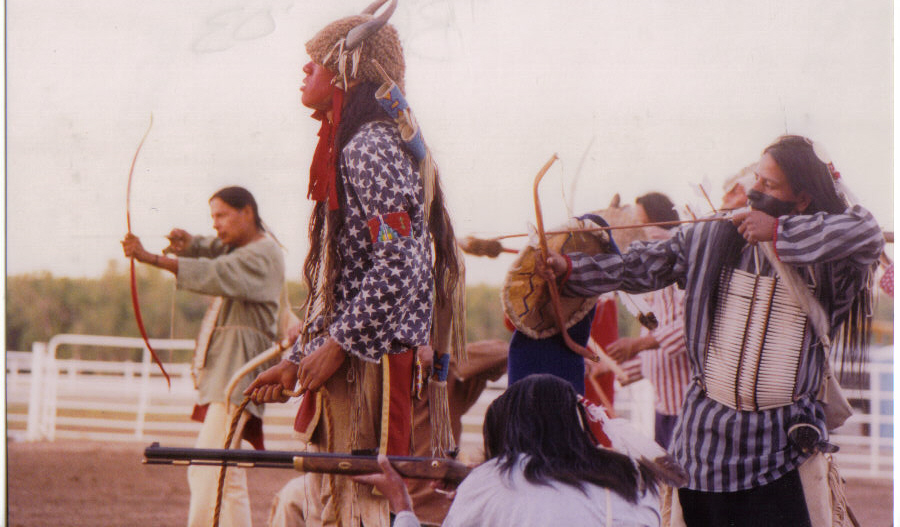
If a 1953 edition of the Fort Pierre Times at the State Archives is correct, the Fort Pierre Rodeo was 129 years old in 1953. That would make the Fort Pierre 4th of July Rodeo 202 years old in 2026. There wouldn’t have been many cattle in that first celebration so mostly horse racing and other events were done like shooting competitions, knife and hatchet throwing, tests of strength etc.
Rodeo originated in the 16th-century Spanish-Mexican ranching culture of the Southwest, evolving from daily tasks of vaqueros (Mexican cowboys) rounding up cattle. The term comes from the Spanish rodear (“to encircle”). These skills were adopted by American cowboys after the Civil War, turning into competitions in the late 1800s. Horses had arrived in 1519 in Mexico with Spanish conquistador Hernando Cortes, and cattle soon followed in 1521 with Gregorio de Villalobos.
After the Civil War, with the abundance of wild cattle in the Southwest and a market in the East, the era of the cattle drives, large ranches, and range cowboys began. Skills of the range cowboy led to competitive contests that eventually resulted in standard events for rodeo.
Perhaps the earliest recorded July 4th Celebration in the Central South Dakota occurred when Explorer Gen. John C. Fremont and scientist Joseph Nicollet celebrated Independence Day on July 4, 1839, at Medicine Knoll (near present-day Blunt, South Dakota). They were leading an expedition for the Corps of Topographical Engineers mapping the region between the upper Mississippi and Missouri Rivers. I believe Fremont’s records show that there was a fireworks display.