

From Sea To Shining Sea – Reflections From 4th of July!
By Sunny Hannum
Perhaps it’s too soon to look back over last week and all the activities preceding 4th of July but many thoughts passed through my head as I participated in or viewed experiences happening here in our hometown and around the country. In view of the fact that most of my generation will never see another 4th of July like this one, I had to put my thoughts into writing.
Most readers will know that Fort Pierre had five days of rodeo activities and two huge fireworks displays. The week culminated with the biggest and BEST parade the morning of the 4th of July. It seemed like the folks decorating the floats went above and beyond status quo. There were to be 20 wagons at least in the parade from a small wagon train coming from east of Pierre. I don’t know if they made it by an 8 a.m. curfew to cross the bridge but I do know that Beth Remund’s team pulling a remuda wagon and pup won “Best Horse Drawn Vehicle”.
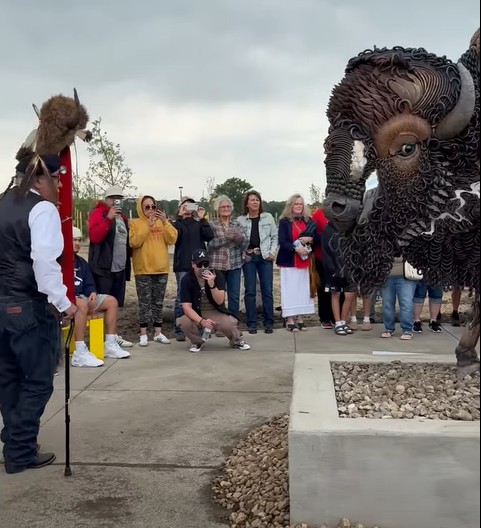
Something else that will be long recognized as a Native American Reconciliation event took place at Drifters Conference Center and Tatanka Trail Park with the Unveiling Ceremony of the “Dupree” bison statue. When then Mayor Hanson and her sculpture committee first decided to commission John Lopez, perhaps ten years ago, to do this statue, I don’t think they realized how significant it would be. The dedication of the statue on July 3rd not only honored the Dupree Family for their ancestor Fred Dupree’s saving of the buffalo but it honored the entire Lakota Nation and Native Americans in general.
The Missouri River valley near the forks of the Bad River had been important to Native Americans for centuries beginning with the Arikara and then the Sioux Nation. Chief Tin Cup often camped on Bad River. In fact, it was just a few miles up Bad River near Teton that an entire camp of Native Americans perished in a flash flood for which Bad River was notorious. Scotty Phillip’s wife, sister to Crazy Horse wife testified that Sitting Bull was born near Willow Creek (Carlisle Ranch) on Bad River as his parents traveled south on the Old Indian Trail.
Woven through all the events, was a spirit of pride in our country and a spirit of celebration to have made it for 250 years. I might add underneath all a determination to preserve this nation and all it has stood for over the decades. As I sat in the bleachers at the 4th of July Rodeo, there was a great spirit of unity as the crowd chanted “USA! USA! USA!” I PRAY THAT SPIRIT OF UNITY GRIPS THIS COUNTRY AND CARRIES US FORWARD.! We have so needed a rebirth, a great awakening, a reformation.
And this brings me to considering the four faces on Mount Rushmore. Let’s look at them from left to right: George Washington (representing the nation’s founding); Thomas Jefferson (representing the nation’s growth); Theodore Roosevelt (representing the nation’s development); Abraham Lincoln (representing the nation’s preservation).
George Washington (February 22, 1732 – December 14, 1799) was a Founding Father and the first president of the United States, serving from 1789 to 1797. As commander of the Continental Army, Washington led Patriot forces to victory in the American Revolutionary War against the British Empire. He is commonly known as the Father of His Country for his role in bringing about American independence. (Wikipedia)
Born in the Colony of Virginia, Washington became the commander of the Virginia Regiment during the French and Indian War from 1754 to 1763. Throughout his military service God had his hand of protection on Washington. In the French and Indian War when all the colonial officers were being killed Washington survived four bullet holes through his jacket that never touched his body and his horse shot from under him. A 2026 historical drama Young Washington, directed by Jon Erwin covers his early life.
Thomas Jefferson was a Founding Father and the third president of the United States from 1801 to 1809. He was the second vice president under John Adams. Jefferson was the primary author of the Declaration of Independence, and a leading proponent of democracy, republicanism and natural rights. Jefferson’s advocacy for individual rights, including freedom of thought, speech, and religion, helped shape the ideological foundations of the revolution.[
Jefferson’s presidency assertively defended the nation’s shipping and trade interests against Barbary pirates and aggressive British trade policies, promoted a western expansionist policy with the Louisiana Purchase, which doubled the nation’s geographic size, and reduced military forces and expenditures following successful negotiations with France. (Wikipedia)
Theodore Roosevelt Jr. was the 26th president of the United States, serving from 1901 to 1909. Previously serving six months as vice president under William McKinley, Roosevelt became president after McKinley’s assassination in 1901. He had resigned as Secretary of the Navy to help form and lead the Rough Riders, a unit that fought the Spanish Army in Cuba to great publicity and returned a war hero.
As a leader of the progressive movement, Roosevelt championed his “Square Deal” domestic policies after taking over as president, which called for fairness for all citizens, breaking bad trusts, regulating railroads, and pure food and drugs. His pursuit of antitrust litigation in particular earned him the nickname “the Trust Buster”. Roosevelt prioritized conservation and established national parks, forests, and monuments to preserve U.S. natural resources. In foreign policy, he focused on Central America, beginning construction of the Panama Canal.
Abraham Lincoln was the 16th president of the United States, serving from 1861 until his assassination in 1865. He led the United States through the American Civil War, defeating the Confederacy and playing a major role in the abolition of slavery. It’s very fitting and probably the artist’s intention to have Washington on the far left and Lincoln on the far right as Washington founded the republic and Lincoln saved it.
On January 1, 1863, he issued the Emancipation Proclamation, which declared the slaves in the states “in rebellion” to be free. On November 19, 1863, he delivered the Gettysburg Address, which became one of the most famous speeches in American history.
Lincoln’s second inauguration took place on March 4, 1865; historian Mark Noll places his second inaugural address “among the small handful of semi-sacred texts by which Americans conceive their place in the world”; it is inscribed in the Lincoln Memorial. Lincoln closed his speech with these words:
“With malice toward none; with charity for all; with firmness in the right, as God gives us to see the right, let us strive on to finish the work we are in; to bind up the nation’s wounds; to care for him who shall have borne the battle, and for his widow, and his orphan—to do all which may achieve and cherish a just and lasting peace, among ourselves, and with all nations.”
Lincoln was assassinated by John Wilkes Booth, a Southern sympathizer, on April 14, 1865 only five days after General Lee surrendered at Appomattox signaling the end of the Civil War.